An inclusive corporate gifting guide
Quick answer: what is a food-free Diwali hamper?
A food-free Diwali hamper is a festive gift collection built without edible items. It can combine a useful everyday object, a keepsake, a reusable container and a personal message. For corporate teams, it offers an alternative when food preferences, ingredient checks or storage requirements make one standard sweets hamper unsuitable. It is not automatically allergy-free: materials, fragrances and individual preferences still need checking.
A thoughtful Diwali gift should be easy to enjoy. Yet the familiar box of sweets can create an awkward moment for someone who cannot eat its contents, does not want food at work or would rather receive something useful. The answer is not to remove celebration. It is to give celebration a different form.
Food-free Diwali hampers let HR and procurement teams plan around usefulness, choice and a warm festive message. They can suit employees, clients and business partners, provided the recipient's gift policy allows the gift. This guide explains how to build an inclusive option, compare it fairly with edible hampers and manage a Bengaluru or wider India gifting programme without making medical claims or delivery promises.
Why this angle matters for Diwali gifting in 2026
Current industry discussion puts employee choice and preferences closer to the centre of festive gifting. EnKash's 2026 corporate Diwali gifting guide discusses usefulness, dietary requirements and personalisation beyond printing a name. That is a useful signal for content and planning, not proof that every Indian employer follows the same practice.
The practical question is simple: can the recipient use the gift comfortably? A team can include people with different diets, allergies, religious preferences and views on sugar or snacks. Their reasons do not have to become part of an employer's records. Offering a non-food option lets people express a preference without explaining private circumstances.
Avoid describing a food-free hamper as a cure for every inclusion problem. A strongly scented candle may be unwelcome. A decorative object may not suit someone's home. A mug may duplicate something they already own. Good curation still begins with the recipient, not with a fashionable label.
Food-free does not mean less festive
Festive character can come from colour, texture, a thoughtful note and an object that fits the occasion. It does not depend on the number of edible items in a box. A restrained gift can feel generous when every component has a clear purpose.
Think of the hamper as a short story. One item is the main gift. Another supports it. The packaging keeps both secure and can have a second use. The message explains why the recipient is being thanked. If an item adds neither usefulness nor meaning, remove it rather than filling an empty space.
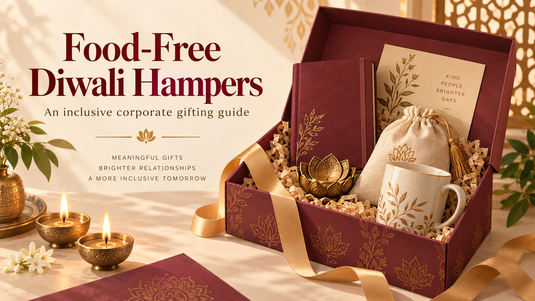
A desk-oriented hamper might pair a notebook with a practical pouch and a greeting card. A home-oriented option might centre on a decorative keepsake with a neutral finish. A daily-use option might start with drinkware, subject to material and care checks. These are planning examples, not confirmed Jadoo Magic bundles or stock promises.
Define who the alternative is for
Decide whether food-free is the main programme or one option alongside an edible hamper. The second route can work well when preferences vary and the company can handle a small number of variants. The first route may simplify ingredient review, but it should still be tested for recipient relevance.
Keep the decision separate from status. A food-free option should not be labelled the lesser gift, the special-case gift or the gift for people who cannot join the celebration. Give alternatives comparable care, presentation and perceived value.
For clients, check acceptance rules before choosing any product. For employees, make eligibility and fulfilment clear. For a mixed audience, separate the client approval process from the employee preference process. One shared catalogue does not mean every recipient has the same permissions or needs.
Choose a useful anchor item
Select one item that carries most of the hamper's purpose. A useful anchor reduces the temptation to buy a collection of small things that look busy but are rarely used. Ask what the recipient is likely to keep after the festival.
For desk use, consider a notebook, organiser or pouch after checking dimensions and finish. For daily use, assess drinkware by material, cleaning instructions and suitability for the intended setting. For home use, check whether a keepsake has a neutral design and can be displayed without taking up too much space.
Do not assume that a natural-looking material proves environmental benefit or durability. Ask for the actual material description and care instructions. If the item is composite, coated or lined, that matters for use and disposal. Describing the real construction is more useful than repeating a broad marketing term.
Check non-food sensitivities
Removing food removes one category of concern, not every concern. Fragrance, latex, metal finishes, dyes and cleaning requirements can still affect suitability. Where information is uncertain, choose a simpler option or let the recipient choose.
Keep fragranced items optional rather than placing them in every hamper. If a candle is considered, review its use instructions and whether the audience would actually want it. Do not assume an office permits open flames or that every home has a suitable place to use them.
A food-free gift also should not be promoted as medically safe for all recipients. That is a claim the contents alone cannot establish. Use plain descriptions such as "contains no edible items" when verified. Avoid "allergy-proof", "diabetic-safe" or "suitable for everyone".
Design two or three clear themes
A small set of themes gives choice without making procurement unmanageable. For example, a desk theme, a home theme and a simple daily-use theme can have different contents but comparable attention to quality. These are suggested structures, not product listings.
Name each theme by use rather than by personality stereotype. "Desk essentials" is clearer than "for the ambitious employee". "Home keepsakes" is better than assuming a recipient's family situation. Useful names help people choose without feeling categorised.
Keep the contents visible. A recipient should know whether a variant includes fragrance, fragile objects or items requiring special care. Product photos, dimensions and a short contents list are more valuable than a long emotional description. If a choice is unavailable, explain the replacement rather than silently changing it.
Keep branding light and messages specific
A corporate gift is received by a person, even when it is funded by a company. Heavy branding on every surface can make the hamper feel like a promotional kit. Choose where branding belongs and where the product should speak for itself.
A sleeve, card or modest mark may be enough. Where personalisation is requested, proof names and spelling before production. If the source list contains initials or different scripts, agree the exact display text rather than guessing.
Use a message that thanks the recipient for a real relationship: their work, partnership or support. Do not invent a personal milestone or imply a closer relationship than exists. A short, sincere note usually fits a gift better than a paragraph of corporate slogans.
Compare the full cost, not the box price
Food-free does not automatically mean cheaper. Durable objects, protective packaging and personalisation can change the total. Compare options using the final contents, quantity, packing, tax, delivery and any artwork costs that apply to the quote.
Also compare effort. An edible hamper may require ingredient and shelf-life checks. A non-food hamper may require material, breakage or care checks. Neither route is effortless; they create different review tasks. Choose the route that fits the recipient and the team's ability to manage it.
Do not use a fixed online price as the final budget for a bulk programme. Ask for a written quotation for the agreed specification and destinations. If a lower-cost version changes the anchor item or container, make that difference visible before approval.
When an edible hamper may still be the right choice
Food is not a problem by default. Some recipients genuinely enjoy festive sweets, dry fruits, tea or other treats. The aim is to provide a thoughtful alternative, not to suggest that edible gifts are outdated or inappropriate.
If food remains part of the programme, obtain the actual product labels and review ingredients, allergen declarations, date information and storage instructions. The FSSAI labelling framework is the relevant starting point for pre-packaged food information in India. An attractive outer gift box should not hide information needed to evaluate the food inside.
Do not treat vegetarian, vegan, gluten-free and no-added-sugar as interchangeable descriptions. They answer different questions. Nor should a marketing description replace the producer's label. For severe allergies or specific health needs, recipients should rely on appropriate professional advice and product-specific information, not a gifting blog.
Bengaluru planning: office distribution versus home delivery
For a Bengaluru programme, first decide where handover will happen. An office collection desk, a team celebration and individual home shipments need different packing and administration. A plan designed for one should not be assumed suitable for another.
If the programme covers offices in areas such as Whitefield, Electronic City or central Bengaluru, use actual office names, delivery contacts and receiving windows. Those location examples are planning context, not claims of Jadoo Magic branches or guaranteed local service. Confirm every destination with the supplier.
For office distribution, label variants clearly and provide a discreet way to change an unsuitable choice. Avoid announcing why someone selected a food-free gift. For home delivery, ask only for the information needed to fulfil the order and tell recipients who will receive it. An office address is not a substitute for a recipient's confirmed home-delivery preference.
Pan-India planning: test the journey, not only the presentation
A gift that looks excellent in a sample can arrive very differently after transit. Consider fragility, item movement and how the recipient opens the package. Request a packing plan for the actual hamper rather than treating a display photo as proof of transport readiness.
For multiple Indian cities, confirm serviceability, transit estimates and any destination-specific restrictions before approving the order. Do not advertise a national arrival date without checking the actual dispatch and courier plan. Jadoo Magic's website promotes pan-India delivery, but a specific programme still needs confirmation of quantities, destinations and timelines.
Where the gift contains a breakable object, agree how damage will be documented and whom recipients should contact. Ask for the current terms in writing. Do not infer replacement, cancellation or return rights from a general promise of customer care.
A practical food-free hamper brief
Write a brief that someone can approve without a follow-up meeting. State the recipient group, intended use, required quantity, delivery approach, branding and the reason a non-food option is being offered. Specify exclusions such as edible items or fragrance where needed.
Include a preferred anchor item, acceptable alternatives and a rule for substitutions. Request materials, dimensions, care instructions and sample photographs. If a reusable container is part of the concept, explain its likely use rather than assuming it will be kept.
Add one point of contact for approval and one for fulfilment. Keep the final specification version separate from earlier ideas. When samples are approved, photograph the agreed arrangement and record the contents so production can be checked against it.
How Jadoo Magic fits into the shortlist
Jadoo Magic's website presents customised hampers and corporate gifting options, including categories for new joiners, client appreciation and eco-friendly gifting. That makes it a relevant starting point for a curated brief. It does not establish that every suggested food-free combination is already offered.
Share the use case and exclusions first. Ask the team which current products can meet the brief, what personalisation is possible and how the hamper would be packed. Request a quote and confirm availability before using product names or delivery commitments in your internal announcement.
Browse the current Jadoo Magic website rather than treating this guide as a catalogue. The best enquiry is specific: "We need a food-free Diwali option with a useful anchor item, minimal branding and no fragrance. Please propose current contents and a delivery plan for our confirmed destinations."
Approval checklist
-
The hamper's contents contain no edible items, if that is the chosen requirement.
-
Themes are named by use and alternatives receive comparable care.
-
Fragrance, materials, dimensions and care instructions have been checked.
-
No allergy-free or medical-safety claim is being made.
-
Client gift acceptance and employee eligibility have been handled separately.
-
Names, artwork, messages and substitutions have written approval.
-
The final quotation includes the agreed packing and destination scope.
-
Delivery contacts and recipient information are current and access is limited.
-
The sample matches the production specification.
-
Damage handling and current supplier terms are understood before commitment.
Frequently asked questions
1. What can go into a food-free Diwali hamper?
A notebook, pouch, drinkware, useful desk item or decorative keepsake can form the core. Choose a small number of compatible items and check their materials and care requirements. These are categories to discuss with a supplier, not a guarantee that every item is currently available.
2. Is a food-free hamper automatically allergy-friendly?
No. Fragrances, dyes, latex or other materials can still be unsuitable for some recipients. Describe verified contents accurately and avoid universal safety claims. Where preferences vary, an optional simpler variant may be more useful than assuming one hamper works for everyone.
3. Should every employee receive the same hamper?
Not necessarily. Comparable options can meet different preferences while keeping the programme fair. Define consistent eligibility and presentation, then let people select from a manageable set. Explain the default for recipients who do not choose before the stated cutoff.
4. Can food-free gifts still feel traditional?
Yes. A festive colour palette, an appropriate keepsake and a thoughtful message can carry the occasion without sweets. Avoid assumptions about how every recipient celebrates. A warm seasonal thank-you can be inclusive without prescribing a ritual or personal belief.
5. What should Bengaluru HR teams confirm before ordering?
Confirm quantities, office or home delivery, receiving contacts, variants, artwork, packing and destination serviceability. Review the actual sample and quotation. Do not assume that a nearby destination eliminates transit risk or that a supplier can meet an unconfirmed arrival window.
6. Does Jadoo Magic offer every example in this guide?
The examples are curation ideas, not verified stock listings. Jadoo Magic presents customised and corporate gifting on its website. Ask its team for current products, specifications, quantities and fulfilment terms before choosing a final hamper or announcing it to recipients.
The takeaway
An inclusive food-free Diwali hamper starts with a useful object and a clear recipient need. Keep the contents understandable, the alternatives fair and the claims modest. A gift does not need sweets to feel festive, and it does not need a crowded box to show appreciation.